Dr. Minish Dental Hospital's first doctor born, passionate man drove twice around the world to prove Minish adhesion...
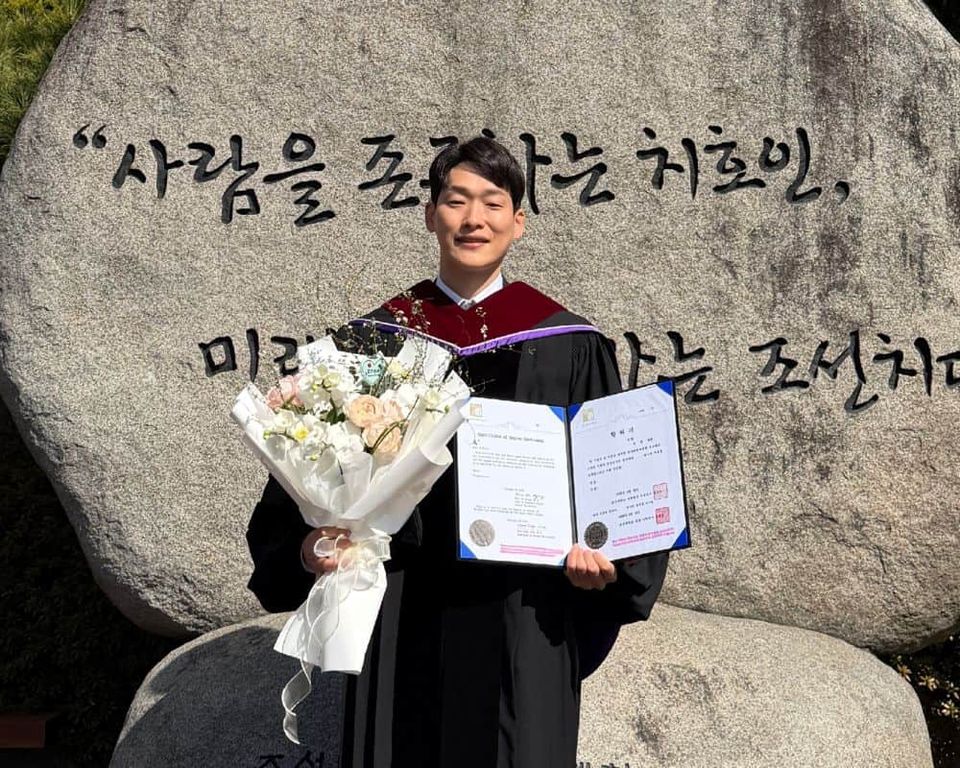
Hae-Sung Kwak, MD, PhD, Chosun University
Minish adhesive method, backed by data
"A PhD is a huge accomplishment and a significant challenge in itself. Considering that statistically, nearly half of all PhD candidates do not complete the dissertation phase, earning the degree is no small feat."
Every Thursday, Dr. Kwak Hae-sung left Seoul at 4 a.m. to travel four hours to Gwangju for class and then back to Seoul at 6 p.m., an eight- to nine-hour day. Adding the trip to Gwangju to his travel schedule on his days off created a cascading effect on his schedule.
"It was kind of easy at first, but it affected my whole schedule like a butterfly effect. I'd come home and write papers until midnight, and it was very lonely and hard."
Two and a half years and 78,520 kilometers traveled. That's enough to circle the globe twice. The reason for starting the PhD program was clear. He needed a scientific basis for validating the materials and adhesion methods used in Minish treatments. "You need evidence anyway," he says, "so the idea was to use Minish materials to get data and create some evidence."
The paper is titled "Adhesive properties of feldspathic ceramic blocks for dental veneers according to different surface treatment methods". The study compared the adhesion strength of a one-step adhesion method (APF+Silane, ammonium polyfluoride and silane are treated in one step) and a conventional two-step method (HF+Silane, hydrofluoric acid is used to corrode the surface and silane is applied separately).
Electron microscopy (FE-SEM, ×10,000) images of the Minish block surface. On the left, the conventional two-step method, on the right, the Minish Dental Clinic's one-step method. The surface structure is slightly different, and the two methods were statistically equivalent in actual adhesion strength measurements.
After designing the experimental design, we tested it directly using Minish blocks and Minish photopolymerizers. The conclusion was that both methods had statistically significantly higher bond strength. Measured in MPa (megapascals, the higher the number, the stronger the adhesion), the one-step method performed equally well at 11.61 MPa and the two-step method performed equally well at 10.90 MPa. This means that both the one-step and two-step methods are reliable.
While there were international papers comparing the two methods, there were not many domestic papers, and especially no data from direct experiments with Minish blocks. We filled that gap. It was also an academic validation of a method that we have been using in the field for three years.
Scanning electron microscopy, FTIR surface chemical structure analysis, and roughness testing were used to verify that the invisible bonding process was working properly through surface observation. "In the past, we've had to clean them with hydrofluoric acid, break the minish, flush them down the drain, and so on, and the one-step method doesn't have that kind of sensitivity." The data validated what they had already been doing in the field.
The help of his lab teachers at Chosun University also helped him. "Since they do a lot of research and write a lot of papers, they taught me a lot over their shoulders, starting with how to use the equipment, and that was a big help. The time I spent writing my thesis every day until past midnight eventually gave me academic depth."
On the day of the degree ceremony, Dr. Kwak expressed his gratitude to his colleagues in a group chat room. "I would like to give this honor to Dr. Jung Ho Kang and Dr. Jin Ho Choi for their support, Dr. Jung Mi Jung for generously supporting the minish block and helping me make the specimens, Dr. Sung Hyeop Kim, and Dr. Hee Jin Woo and Dr. Bo Ram Shin for helping me with the experiments day and night."
"This research is a further step in strengthening and validating the direction Minish has been headed, and our goal is to continue to grow Avidence."
Get new stories from Minish in your inbox.
Check your inbox and confirm your subscription.
Something went wrong. Please try again.