[Interview] "Minish Platform Global Expansion... Aiming for 20 Billion in Revenue this Year"
![[Interview] "Minish Platform Global Expansion... Aiming for 20 Billion in Revenue this Year"](https://storage.ghost.io/c/c1/f6/c1f64215-c84f-40a8-be4a-fce0a462acd7/content/images/size/w960/2026/10/250602_gangjeonghodaepyo_01.jpg)
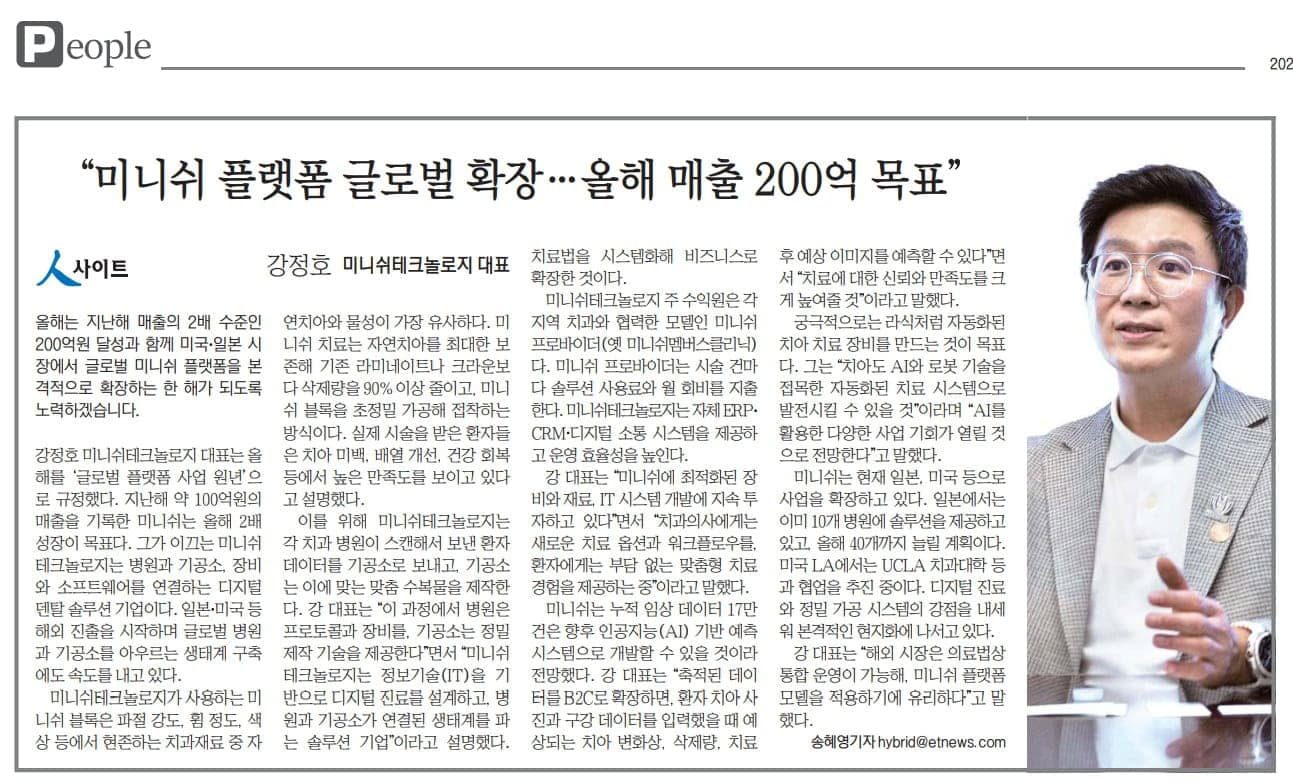
"This year, we will strive to double last year's revenue to 20 billion won, as well as expand the global Minish platform in earnest in the US and Japanese markets."
Minish Technology CEO Kang Jung-ho has characterized this year as "the first year of the global platform business. Minish, which posted sales of about 10 billion won last year, aims to double its growth this year. His company is a digital dental solution company that connects hospitals and laboratories, equipment and software. The company is expanding overseas to Japan and the United States to build an ecosystem that includes global hospitals and laboratories.
The Minish blocks used by Minish Technology have the closest physical resemblance to natural teeth of any dental material in the world, including fracture strength, bendability, and color. The Minish treatment preserves as much of the natural tooth as possible, removing more than 90% less than traditional laminates or crowns, and bonding the Minish blocks with ultra-precise machining. Patients who have undergone the procedure have reported high levels of satisfaction with the whitening, alignment, and restoration of their teeth.
To do this, Minish Technology sends patient data scanned by each dental hospital to the laboratory, which then creates customized restorations. "In this process, the hospital provides protocols and equipment, and the laboratory provides precision manufacturing technology," Kang said. "Minish Technology is a solution company that designs digital medical treatment based on information technology (IT) and sells an ecosystem where hospitals and laboratories are connected." It's a systematization of a treatment into a business.
Minish Technology's primary revenue stream is from Minish Providers (formerly known as Minish Members Clinics), a model that partners with local dentists. Minish Providers pay a solution fee for each procedure and a monthly membership fee. Minish Technology provides its own ERP, CRM, and digital communication system and increases operational efficiency.
"We continue to invest in developing equipment, materials, and IT systems that are optimized for Minish," says Kang, "to provide dentists with new treatment options and workflows, and patients with a personalized and affordable treatment experience."
Minish said the 170,000 cases of accumulated clinical data can be developed into an AI-based prediction system in the future. "If we expand the accumulated data to B2C, we can predict the expected tooth changes, the amount of erosion, and the expected post-treatment image by inputting the patient's tooth photos and oral data," Kang said, "which will greatly increase trust and satisfaction with the treatment."
Ultimately, the goal is to create an automated dental treatment like LASIK. "Teeth can be developed into an automated treatment system that combines AI and robotics," he said, "and we expect various business opportunities to open up using AI."
Minish is currently expanding to Japan, the United States, and beyond. In Japan, the company already provides solutions to 10 hospitals and plans to expand to 40 this year. In Los Angeles, the company is collaborating with UCLA School of Dentistry. With the strengths of digital medical treatment and precision machining systems, the company is working on full-scale localization.
"Overseas markets are favorable for applying the Minish platform model because they are able to integrate operations under healthcare laws," Kang said.
Get new stories from Minish in your inbox.
Check your inbox and confirm your subscription.
Something went wrong. Please try again.