Undermining Minish Value, No More... Read the Book
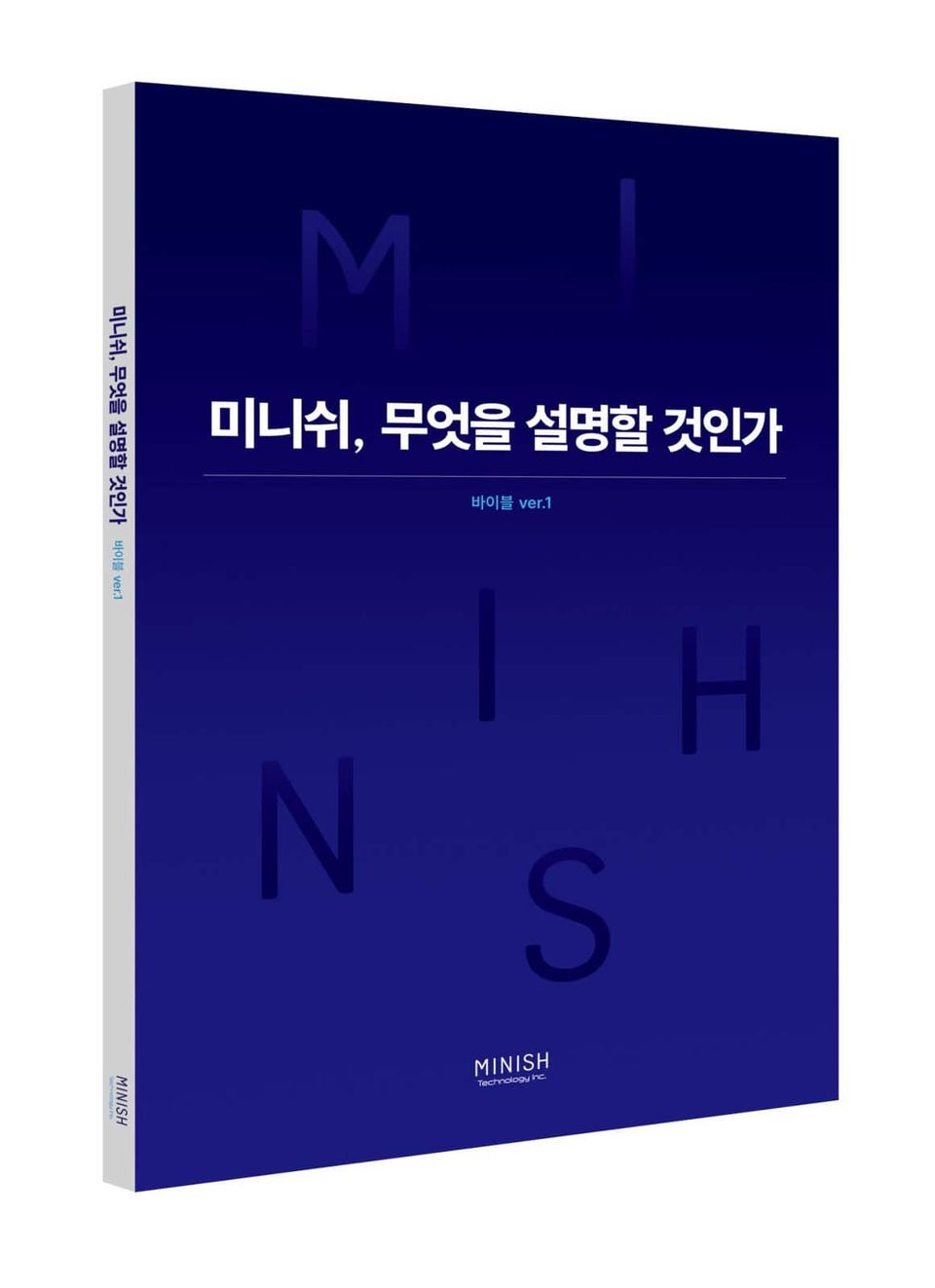
Creating the Physical Handbook Bible 1.0
Persuade with our frames and explain with
'one voice'
pg 124 8-part in-depth organization
We have a reference point for communicating Minish values in the same voice.
The in-house training manual "Minish, What to Explain - The Bible ver.1" will be released today. The book is designed to help Minish group members speak the same language when explaining Minish, whether they're in the counseling room or at their desks, or in marketers or programmers.
If the book, published in October 2024, explained the history of the company, the words of the CEO, and the differences between minish and no-laminate, the Bible aims to fully communicate and convince people of the value of minish.
The book is organized into eight parts, totaling 124 pages. Part 1, "20 Years Toward Patients," was written by CEO Kang Jung-ho himself. From the opening of Seongnam in 2005, to the establishment of the one-day system, to the research achievements and reasons for the establishment of technology while enduring deficits during the Apgujeong era, the narrative of 20 years of Minish is vividly told in the first person. This is the starting point for understanding how Minish's treatment philosophy was born out of his own experiences.
Parts 2-4 cover treatment principles and tooth anatomy, emphasizing that Minish is not a treatment to be compared to laminates, but a new field of treatment in its own right. Part 3, "Understanding Teeth to See Minish," explains the principles of tooth damage, including wear and tear, corrosion, and incontinence, and the science behind why resin, crowns, and endodontics lead to a "circle of death. "The more you know, the more you can explain," says Dr. Minish.
Part 5, "The History of Clinical Problem Solving," the longest part of the book, explains that the nine previously effect-oriented lineup (White, Revive, Ever, Pink, Combo, Bridge, Line, Molar, and Full Mouth) are not just marketing products. It explains how a doctor's conscience, which forced him to say "don't touch" in front of a 50-year-old patient's worn teeth, led to the innovation of Minish Ever.
Parts 6-7 introduce the three pillars that support Minish: the ecosystem of providers, the Qigong Institute, and Minish courses. Finally, Part 8, "The Art of Perspective Shifting Conversations," proposes a way of explaining the preceding knowledge from our frame, not the questioner's. It includes counseling methods for each type of customer's problem, phrases you should never use, and official answers to frequently asked questions to maximize practical use.
"Just like the title of version 1, this book is not complete, but a beginning," said Choi Rak-sun, head of the communications office, "and we will improve it periodically."
Get new stories from Minish in your inbox.
Check your inbox and confirm your subscription.
Something went wrong. Please try again.