The U.K. and the U.S. Are Going to Great Lengths to Address the “Dental Desert” Problem
The term “dental desert” still sounds unfamiliar to us. This is because it is not particularly difficult to see a dental specialist, not only in Seoul but also in major small and medium-sized cities across the country.
In an article published in the British Dental Journal in 2024, Dr. Stephen Clark, a researcher at the University of Leeds in the UK, defined a “dental desert” as follows: “An area where access to dental care is limited, such as where it is impossible to accept new dental patients through the UK National Health Service (NHS) and where the capacity to treat existing dental patients is reduced.” Simply put, it refers to areas where it is difficult to receive treatment at dental clinics covered by health insurance.
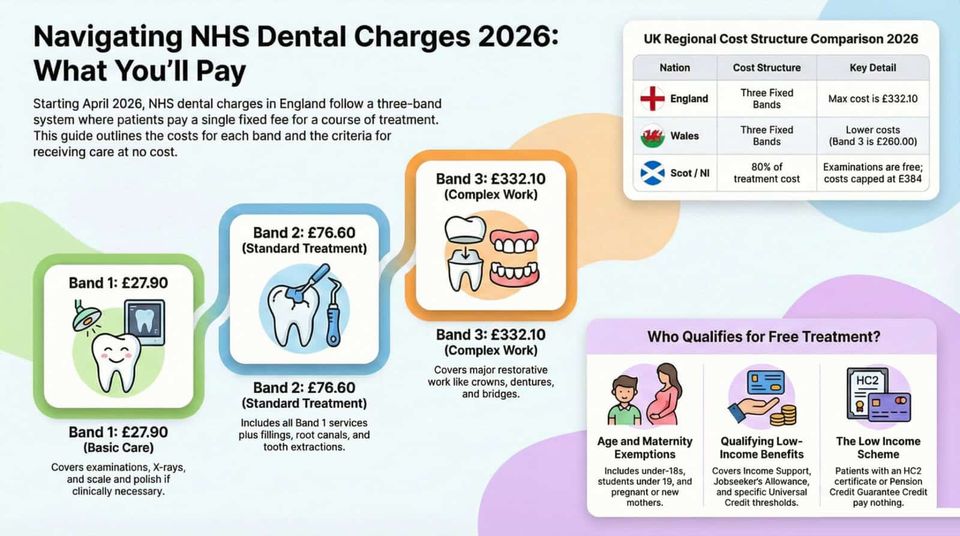
It is commonly believed that the UK’s health insurance system involves long wait times but is free. While it isn’t free, the costs appear to be low. The NHS website categorizes dental checkups covered by the UK’s health insurance system into Bands 1–3. For checkups, teeth cleaning, or gum treatments—all classified as Band 1—patients must pay 27.9 pounds (approximately 58,000 won). Scaling falls under Band 1 if the dentist deems it necessary for treatment; otherwise, the patient must pay the full cost out of pocket. Band 2 costs 76.6 pounds (approximately 160,000 won) and covers procedures such as tooth extractions, fillings (including amalgam), root canal treatments, and wisdom tooth extractions. Band 3 covers procedures such as crown restorations and orthodontic treatment, with a patient copay of 332.1 pounds (approximately 691,000 won). Additionally, emergency treatments for cavities or dental injuries incur a 27.9-pound copay. Considering the cost of living in the UK, these fees appear relatively affordable.
The problem is that it is difficult to receive dental care covered by health insurance. The reasons cited include a shortage of dentists and low reimbursement rates. Furthermore, it has been pointed out that because reimbursement rates for complex procedures requiring significant clinical expertise are insufficient, it is more profitable for dentists to perform multiple simple procedures. According to a BBC News report from March of this year, a 15-year-old girl who had been undergoing orthodontic treatment was unable to schedule an appointment since May of last year. As a result, she is reportedly in pain—including from her braces digging into her cheeks—but is unable to receive treatment. The report also stated that from January 2021 to May of last year, more than 3,500 patients visited the emergency room at a hospital in Swindon, Wiltshire, UK, due to toothaches and other dental issues. People are forced to endure the pain until they can no longer avoid going to the emergency room. In December 2025, The Guardian reported that some patients had even resorted to pulling out their own teeth because they could no longer bear the pain.
Citing the civic group Healthwatch England, The Guardian reported that patients unable to receive timely dental care through the NHS travel more than 100 miles (161 km) to seek treatment in other regions, or spend hundreds of pounds(tens to hundreds of million won) at private clinics, or even travel abroad to receive dental care.
To address this issue, the U.K. Department of Health and Social Care announced on June 3 that it would expand enrollment quotas at dental schools. A total of 50 new spots—25 each at the University of Portsmouth and the University of East Anglia—were created.
In the United States, dental care is paid for out of pocket unless you have premium private dental insurance. As a result, getting a crown on a single tooth can easily cost between 2 million and 3 million won. However, even if you can afford this, there are quite a few neighborhoods where there is a shortage of dentists. According to a January 2025 study by a research team led by Professor Hwajin Elani at Harvard School of Dental Medicine, rural areas have one dentist for every 3,850 people, while urban areas have one dentist for every 1,470 people. By region, Alaska had a population living in dental deserts as high as 10.4%, and states with large rural areas—such as Montana (7.8%) and North Dakota (7.7%)—also had high rates of dental deserts. Washington, D.C., along with Connecticut, Delaware, New Jersey, and Indiana, were found to have no dental deserts.
By state, Alaska had the highest percentage of residents living in dental care deserts (10.4%), followed by Montana (7.8%) and North Dakota (7.7%). Only four states—Connecticut, Delaware, Indiana, and New Jersey—and Washington, D.C., were found to have no dental care gaps.
According to a paper titled “Personal and Institutional Factors Affecting the Clinical Practices of Dentists in Medically Underserved Areas,” published this year by Professor Elani’s research team, the primary reason for this regional shortage of dentists is the cost of dental school tuition. The Doctor of Dental Surgery (DDS) program at Columbia University’s College of Dental Medicine in New York—one of the top dental schools in the U.S.—has an annual tuition of $125,320 (approximately 200 million won). When the cost of living in Manhattan is factored in, annual expenses can easily exceed 300 million won. Citing the study’s findings, *The Harvard Gazette*, Harvard University’s official website, noted that new dentists graduating from dental school must repay student loans ranging from as little as $200,000 (approximately 300 million won) to as much as $600,000 (approximately 900 million won). Among some dentists, there were even cases where student loan debt reached $800,000 (approximately 1.2 billion won). As a result, analysts suggest that the opening of dental practices is concentrated in urban areas where there is a high concentration of wealth.
Professor Elani’s team also pointed out that while dentists actively consider working in rural areas or dental deserts early in their careers, this tendency diminishes as they gain more experience. Furthermore, analysis suggests that dentists with specialties—such as orthodontists and periodontists—are more reluctant to open practices in dental deserts than general dentists. This highlights the urgent need for policy support to address this issue. Last May, in Lexington, a major city in Kentucky, a local television station even filmed and aired a news story when a new dental clinic opened in a neighborhood with a shortage of dentists.
In countries such as the United Kingdom and the United States, the shortage of dentists in rural areas and other “dental deserts” is a problem on a completely different scale than in Korea. Of course, there is also a shortage of dentists in rural areas here in Korea, and to address this, it will be necessary to create an environment that enables dentists to practice in rural areas.
Writer. Hyuntaek Lee
<A former newspaper journalist who worked for 18 years at JoongAng Ilbo>, <and Chosun Ilbo>. She is currently working as a freelance contributor and planning the second act of her life. In addition to journalism, she has worked in public relations and marketing at JTBC Broadcasting and Edelman Global Advisory in the United States.
Get new stories from Minish in your inbox.
Check your inbox and confirm your subscription.
Something went wrong. Please try again.